Why Future-Back Planning Outperforms Traditional Strategy: Evidence from Neuroscience and Practice
- 67% of well-formulated strategies fail due to poor execution
- 60-90% of strategic initiatives never fully launch
- Companies using future-back planning achieved 300% share price growth in under 4 years
Leadership teams invest thousands of hours in strategic planning, yet the execution gap remains stubbornly wide. Research indicates that 67% of well-formulated strategies fail due to poor execution, while studies consistently show that somewhere between 60-90% of strategic initiatives never fully launch or achieve their intended outcomes.
The problem isn’t effort or intelligence—it’s methodology. Traditional planning approaches anchor leaders to present-day constraints, creating what organizational psychologists call «temporal myopia»: an inability to think beyond current limitations.
This cognitive trap manifests across industries, with organizations defaulting to incremental improvements rather than breakthrough innovation, allowing short-term operational pressures to crowd out strategic focus, and rarely questioning the self-limiting beliefs that constrain ambition.
The problem isn't effort or intelligence—it's methodology
The Neuroscience of Future-Back Thinking
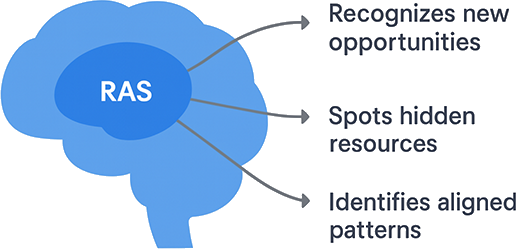
Emerging research in cognitive neuroscience reveals why future-back methodologies produce fundamentally different results. When leaders engage in vivid, multi-sensory visualization of achieved future states, they activate the brain’s Reticular Activating System (RAS)—a neural network that functions as an attention filter for incoming information.
The RAS doesn’t distinguish between vividly imagined experiences and actual events, which means detailed visualization primes executive attention to recognize opportunities, resources, and patterns aligned with the envisioned future that would otherwise remain invisible. Leaders begin seeing their environment through a different cognitive lens—one oriented toward possibility rather than constraint.
The implications extend beyond attention. Research on future-oriented thinking demonstrates that treating goals as already-achieved identities strengthens commitment and enhances creative problem-solving. Athletes have leveraged mental rehearsal principles for decades. When applied to organizational strategy, similar mechanisms increase persistence, reduce anxiety about ambitious targets, and unlock novel approaches to complex challenges.
The RAS doesn't distinguish between vividly imagined experiences and actual events
Bypassing Cognitive Biases
Perhaps most importantly, working from an imagined future helps bypass two of the most destructive cognitive biases in strategic planning: loss aversion and sunk-cost thinking.
Nobel laureate Daniel Kahneman’s research demonstrates that losses loom approximately 2 to 2.5 times larger than equivalent gains in human decision-making. When leaders project forward from today, they naturally overweight what might be lost and undervalue what could be gained. They also remain anchored to past investments that no longer serve future success.
Future-back planning inverts this dynamic, allowing teams to ask «what enabled our success?» rather than «what might we lose?»
Losses loom approximately 2 to 2.5 times larger than equivalent gains in human decision-making
Traditional planning:
Losses feel 2-2.5x bigger than gains
What might we lose?
Future-back planning:
Bypasses loss aversion
What enabled our success?
The Performance Gap: Real-World Evidence
The performance differential between future-back and traditional planning approaches shows up clearly in organizational outcomes. Analysis of companies employing structured future-back methodologies reveals results that diverge sharply from typical strategic planning outcomes. Three documented cases illustrate the potential:
Fortune 50 Company
Tripled share price in under four years — outpacing market indices and competitors.
Technology Enterprise in Crisis
40% revenue growth during the 2008 economic downturn — while most tech firms contracted.
Consumer Brand Turnaround
Reversed 3 years of decline and returned to strong growth.
These aren’t isolated successes during favorable conditions. They represent breakthrough performance precisely when external circumstances made bold strategic moves most difficult and most necessary—suggesting that the methodology may be particularly valuable during periods of disruption or uncertainty.
Beyond financial metrics, organizations consistently report qualitative shifts that predict sustained high performance: dramatic increases in leadership alignment, measurably higher engagement scores, accelerated decision-making velocity, and enhanced confidence in executing ambitious initiatives.
Stay ahead of change.
Get insights on future-back thinking, neuroscience, and strategic innovation — straight to your inbox.
What Distinguishes Effective Future-Back Methodology
Not all visioning exercises produce results. The strategic planning landscape is littered with inspiring vision statements that never translated into meaningful change. The critical question becomes: what separates high-impact future-back approaches from conventional planning sessions?. Analysis of successful implementations reveals three critical factors:
1. Multi-sensory Immersion Creates Psychological Ownership
Neuroscience research shows that experiences engaging multiple sensory modalities create stronger memory encoding than abstract conceptual learning. When leadership teams engage all senses—visualizing physical spaces, imagining customer conversations, describing cultural atmosphere, articulating market headlines—the future becomes tangible rather than theoretical.
This sensory richness activates broader neural networks and creates psychological ownership that abstract goal-setting cannot achieve.
In practice, this means moving beyond PowerPoint presentations of strategic objectives. Effective future-back sessions guide leaders to close their eyes and mentally “walk through” their organization at a specific future date—often three to five years ahead or when a major aspiration has been achieved.
Facilitators prompt: “Look around: what do you see in your offices, your markets, your customers? What’s being celebrated today that was only a dream a few years ago? Who’s in the room, what’s the energy like, what headlines are being written about you?”
“I often have to remind myself it's not yet the future we envisioned. It feels that real.”
— CEO, Bio-Tech Company
2. Systematic Reverse-Engineering Identifies Critical Path Dependencies
Working backward from achieved success helps leaders map the pivotal decisions, cultural shifts, and strategic milestones that enabled breakthrough outcomes. This future-back mapping bypasses the paralysis that comes from analyzing current constraints and reframes challenges as solvable steps already proven effective from the future vantage point.
The conversation shifts fundamentally. Rather than speculation (“if we could…”), leaders engage in evidence-based conviction (“we did it by doing…”). From their future vantage point, the path becomes clearer: what barriers had to be removed, what enablers accelerated momentum, what 3–5 strategic breakthroughs proved most critical.
This reverse-engineering process typically produces what practitioners call “Future-Informed Priorities”—clear, actionable initiatives that are collectively owned rather than mandated from above.
The conversation shifts from ‘if we could...’ to ‘we did it by doing...
3. Immediate Translation into High-Impact Initiatives Maintains Momentum
Research on goal achievement consistently shows that implementation intentions—specific plans linking situations to behaviors—dramatically increase goal-attainment rates compared to goal-setting alone. The most effective future-back methodologies convert insights into concrete execution plans immediately.
These are often framed as “Hero Missions”: short, inspiring initiatives focused on high-impact challenges crucial to realizing the future vision. Each mission targets specific outcomes with meaningful impact on EBITDA, revenue, or other vision-critical factors. Cross-functional leaders take ownership, creating visibility and urgency.
Without this bridge between vision and execution, even powerful future-back experiences risk decaying into motivational memories rather than sustained organizational change.
The Social Dynamics of Collective Future-Building
Individual visualization produces results, but collective future-building generates organizational transformation. When leadership teams craft future narratives together—debating what success looks like, negotiating priorities, synthesizing perspectives into shared stories—they create psychological safety and distributed ownership that top-down strategic mandates cannot achieve.
"For the first time, my leaders truly owned their process.”
— Founder and Chairman, Multi-Billion Dollar Business Portfolio
This collaborative narrative-building leverages social-proof and consistency mechanisms well-documented in social psychology. When leaders publicly commit to specific aspects of the future vision, they experience cognitive pressure to align subsequent actions with those commitments.
When teams hear themselves articulating bold possibilities, self-perception dynamics suggest they begin believing those possibilities are achievable.
The future vision becomes something the team collectively owns rather than something imposed by consultants or executives.
The synthesis of individual contributions into collective artifacts—future newspaper headlines, annual reports written from years ahead, customer testimonials describing breakthrough experiences—creates tangible north stars that guide subsequent strategic decisions.
Unlike static planning documents filed after the offsite, these living reference points help teams evaluate priorities, allocate resources, and navigate uncertainty with greater consistency.
Implications for Strategic Practice
The accumulated evidence challenges prevailing orthodoxy about strategic planning. Perhaps the fundamental question shouldn’t be “what can we achieve given current constraints?” but rather “what constraints must we remove to reach our most valuable future?”
This inversion doesn’t ignore present reality—effective future-back planning requires rigorous diagnosis of current performance, market position, and organizational capabilities. But it refuses to let that diagnosis define the boundary of possibility. Instead, it uses the gap between present and envisioned future to identify the specific barriers, assumptions, and capabilities that must evolve.
For organizations navigating rapid change, technological disruption, or market transformation, future-back thinking increasingly looks less like innovation and more like survival strategy.
Research shows that industry leadership positions now turn over faster than in previous decades. Incremental planning assumes continuity. Future-back planning assumes discontinuity and asks how organizations can drive rather than react to fundamental shifts in their competitive landscape.
The performance data from organizations mastering these methodologies—300% share-price growth, 40% revenue expansion during economic crisis, reversal of multi-year decline—suggests the approach delivers not marginal improvements but breakthrough outcomes.
Combined with consistent reports of enhanced alignment, engagement, and execution velocity, the evidence points toward a fundamental rethinking of how organizations approach strategy.